
2026-04-03 / 6 min read
Generate Better Mock Data for Testing in Minutes (Without Breaking Your Workflow)
Learn how to generate realistic mock data in minutes, improve test reliability, and avoid workflow-breaking data issues.
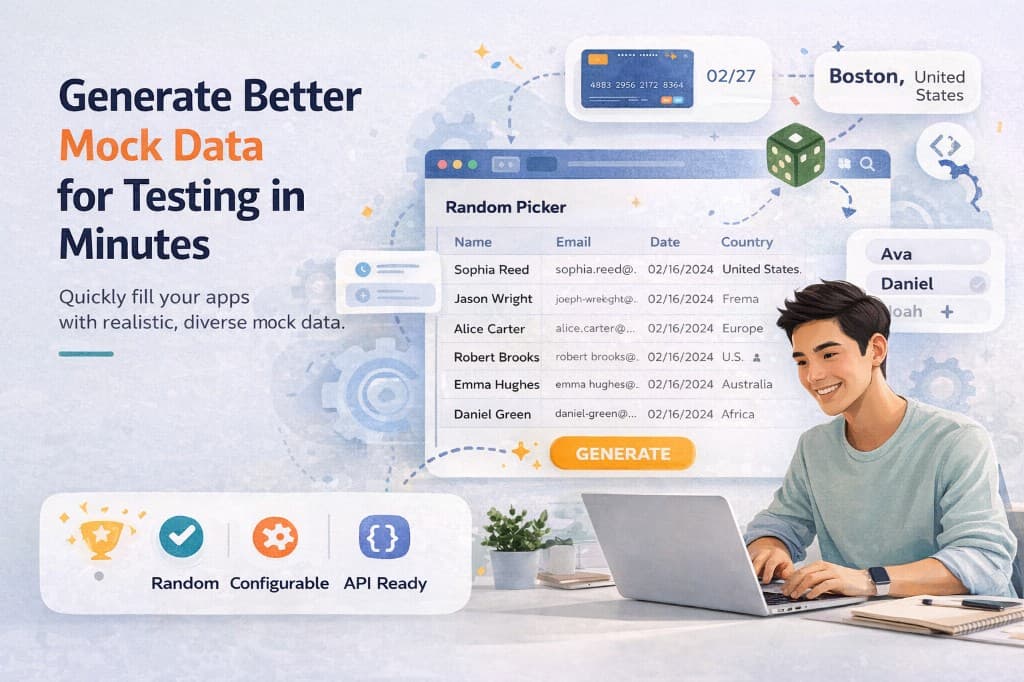
Introduction
If you have ever shipped a feature only to watch it fail in staging, your test data may be the real issue.
Most developers do not struggle with logic. They struggle with weak mock data: empty fields, unrealistic values, and missing edge cases.
The good news is you do not need hours of spreadsheet cleanup. With the right approach, you can generate better mock data in minutes and trust your testing environment.
Why Mock Data Matters More Than You Think
Testing with placeholder values like John Doe and 123456 is no longer enough for modern apps.
Real systems depend on users, payments, location, APIs, roles, and permission rules. If data does not match reality, tests cannot match reality either.
What High-Quality Mock Data Helps You Achieve
Catch real-world bugs before production
Simulate user behavior more accurately
Improve API reliability and response testing
Stress-test your system with meaningful edge cases
Speed up development cycles
In short: better data leads to better decisions.
What Makes Good Mock Data?
Not all fake data is useful. Strong test data generation follows clear principles.
1. Realistic Structure
Names, emails, addresses, and formats should look real, not random strings.
2. Data Relationships
Users should have orders, orders should have timestamps, and records should connect logically.
3. Edge Case Coverage
Empty and null values
Include blanks intentionally to validate required-field handling.
Extreme length and special characters
Test very long inputs and symbols to catch validation and rendering issues.
Duplicate and invalid entries
Use duplicates and malformed formats to verify system resilience.
4. Scalability
You should be able to generate 10 records or one million without rewriting your setup.
Best Tools to Generate Mock Data Fast
You do not need to build everything from scratch.
Faker (JavaScript / Python)
A go-to library for developers that generates realistic names, emails, addresses, and more.
Useful keyword intent: faker js, mock data generator, test data generation.
Mockaroo
A powerful web-based tool for generating structured datasets with custom schemas.
Useful keyword intent: mockaroo alternative, fake data generator online.
JSON Server + Seed Scripts
Great for local API simulation with dynamic datasets.
Useful keyword intent: mock api data, json mock server.
Postman Mock Servers
Ideal when frontend or integration testing starts before backend endpoints are ready.
Useful keyword intent: api testing mock data, postman mock server.
How to Generate Mock Data in Minutes (Step-by-Step)
Keep it practical and repeatable.
Step 1: Define Your Schema
Start with your real structure: user ID, name, email, signup date, subscription status.
Step 2: Choose a Generator
Pick tools like Faker or Mockaroo based on your tech stack and output format needs.
Step 3: Add Variations
Do not only generate happy-path records. Include null values, invalid formats, and boundary limits.
Step 4: Automate It
Use scripts to regenerate data for each test run. Automated test data generation quickly becomes a major workflow advantage.
Pro Tips for Smarter Test Data
Use Seeded Data
Seeds keep outputs consistent across runs for reproducible debugging and QA.
Mix Static + Dynamic Data
Use static fixtures for stability and dynamic data for realism.
Simulate Real Users
Think in behavior flows, not only field formats.
Test at Scale
Do not stop at 100 records. Run larger volumes such as 10,000+ to expose performance bottlenecks.
Common Mistakes to Avoid
Using identical data in every test
Ignoring edge cases
Hardcoding values that fail easily
Forgetting localization needs such as dates and currencies
Not updating mock data as the app evolves
Final Thoughts: Faster Testing Starts with Better Data
If testing feels slow or unreliable, the bottleneck may be your data quality, not your code quality.
A few minutes spent on smarter mock data generation can reduce bugs, speed up QA cycles, and improve application resilience.
Once you start testing with realistic data, it is very hard to go back.
FAQs
1. What is mock data in software testing?
Mock data is artificially generated data used to simulate real-world scenarios during development and testing without exposing real user data.
2. What is the best tool for generating mock data?
Popular options include Faker, Mockaroo, and Postman Mock Server, depending on your stack and workflow.
3. How can I generate realistic test data quickly?
Use Faker libraries or tools like Mockaroo to generate structured, realistic datasets in minutes.
4. Why is realistic mock data important?
It uncovers real-world bugs, improves test accuracy, and helps ensure stable behavior under varied conditions.
5. Can mock data be automated?
Yes. You can automate test data generation in CI/CD to keep testing consistent, fast, and scalable.